

Aviator Game Review: What We Could Verify
In short — our verdict: 7.3/10 — Aviator is a Spribe crash game whose result is fixed by a hash before the plane moves, and 97% is the only return figure the studio publishes anywhere. We reproduced three rounds from their seeds.
You can open Aviator without an account, and the first thing worth knowing is that the round is already decided before the plane moves. We played ten rounds in Spribe's official demo on and rebuilt three of them from their seeds.
7.3/ 10
- Fairness you can check yourself7.5
- Numbers the studio publishes5.5
- Controls and safety rules8.5
- Supplier's regulatory record6.0
- Free access before you deposit9.0
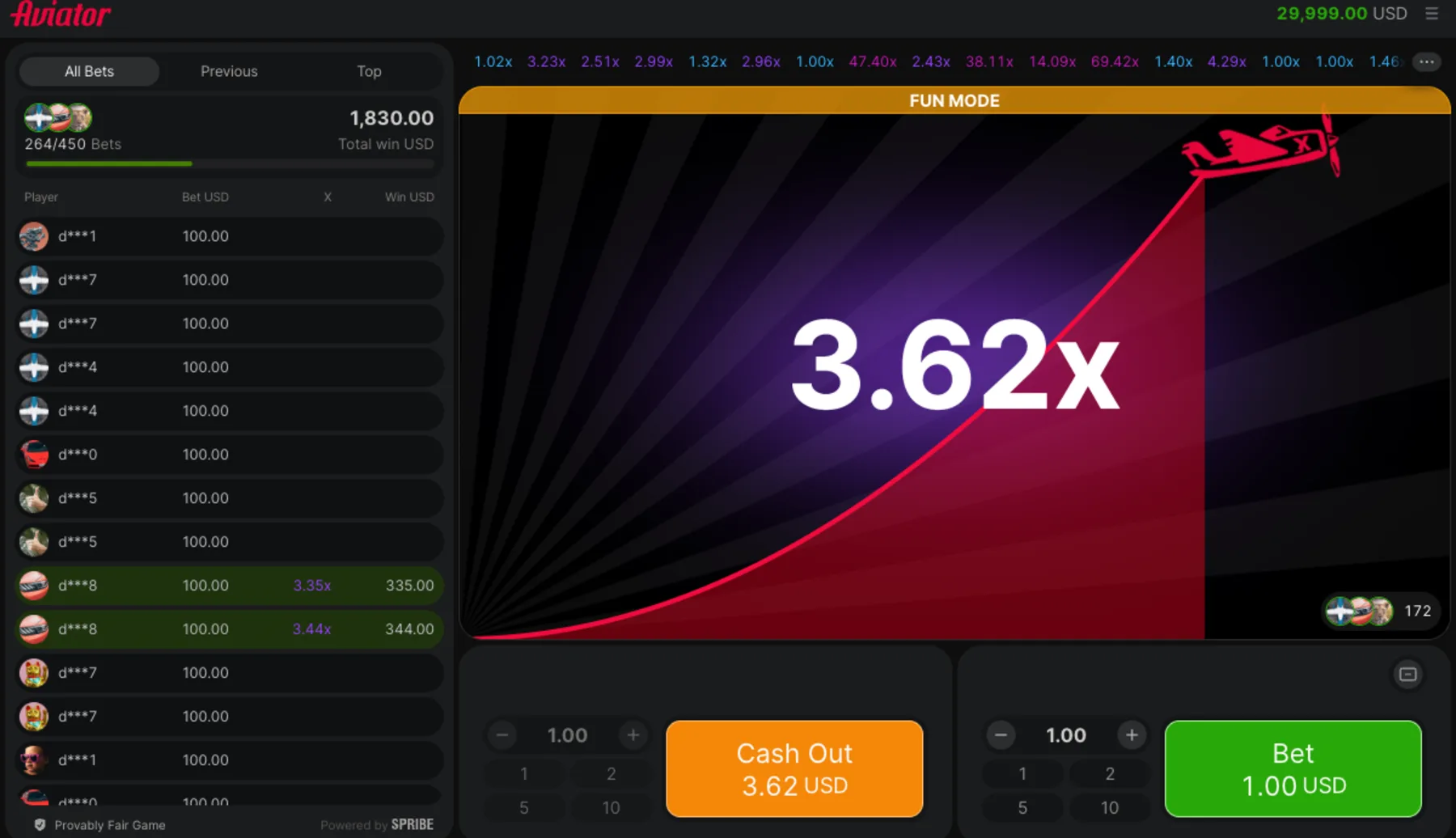
Table of contents
- Aviator Strengths and Weaknesses
- Our Ten Demo Rounds, 29 September 2026
- Aviator in One Screen
- A Round, Start to Finish
- The Curve Is Printed in the Client
- The Missing Return Figure
- Ten Rounds, Written Down
- We Reproduced Three Rounds
- The Studio Behind It
- Lobbies That Carry It
- Flight Time Against Multiplier, by the Client's Own Formula
- Our Aviator Verdict and Rating
- Key Terms Used on This Page
- What Else Do Readers Ask
Aviator Strengths and Weaknesses
Pros: What Works Well
- Pro: The round result can be rebuilt from its seeds in about a minute, and we did it three times
- Pro: The growth curve is printed in the client, so multiplier and flight time are the same question
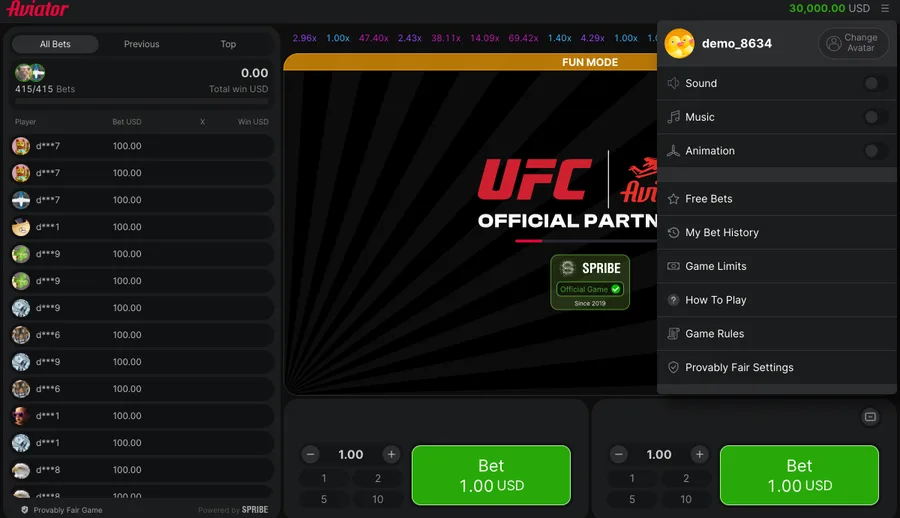
- Pro: The demo starts you on 30,000.00 of play credit with no account at all
- Pro: Two bets, Auto Cash Out and three Auto Play stop conditions all sit in the free client
- Pro: A lost connection closes an active bet at the current multiplier instead of voiding it
Cons: What Holds It Back
- Con: Spribe publishes no volatility rating for Aviator, in any form, anywhere
- Con: The return figure travels with the deployment, so the 97% on the studio's page need not be the figure in your lobby
- Con: The demo's rules panel shows no return-to-player section at all
- Con: We could not match a published next-seed hash to any seed later revealed, so the commitment half stays unverified
- Con: No laboratory publishes a certificate naming this title, and the in-game notice names none either
- Con: The supplier carries a UK regulator warning dated
Our Ten Demo Rounds, 29 September 2026
| Round time | Stake USD | Cashed out at | Round ended at |
|---|---|---|---|
| 18:16 | 1.00 | 7.39x | 10.27x |
| 18:17 | 1.00 | not cashed | 1.36x |
| 18:18 | 1.00 | 2.04x | not recorded, above 2.04x |
| 18:18 | 1.00 | not cashed | 1.70x |
| 18:18 | 1.00 | not cashed | 1.70x |
| 18:19 | 1.00 | not cashed | 2.43x |
| 18:24 | 1.00 | not cashed | 3.00x |
| 18:24 | 1.00 | not cashed | 3.00x |
| 18:25 | 1.00 | not cashed | 1.64x |
| 18:26 | 1.00 | not cashed | 2.13x |
Figures current as of ; the operator's live terms prevail.
Aviator in One Screen
Aviator is a crash game. A multiplier starts at 1x, climbs while a plane flies across the screen, and the stake is gone if the plane leaves before you cash out. Spribe files it under "Mini Game" on the studio's own site and describes it as "a new kind of social multiplayer game consisting of an increasing curve that can crash anytime". The crash label comes from the industry, not from the studio.
Two bets can run in the same round. That's the first thing newcomers miss, and in the official demo both panels sit open side by side, each with its own stake box and its own green button.
Spribe's portfolio around it includes Pilot Chicken, Mines, Plinko, Goal and Balloon, so the studio isn't a one-title operation. Aviator is simply the title that travelled.
A Round, Start to Finish
Bet before take-off, watch the multiplier climb, cash out or lose. The result, though, is settled before any of that happens: the multiplier at which the plane leaves is generated from seeds the moment the round opens, so nothing you do in the air changes where it ends.
One rule the client states twice and almost nobody repeats: an exact tie loses. "If the plane takes off exactly when the multiplier matches the one you've chosen for automatic cashout, the round is counted as a loss." Set an automatic cash out at 1.50x, watch the plane leave at 1.50x, and the round is gone. The client spells out the arithmetic behind that too, saying a crash at 1.25x means the multiplier reached 1.24x and then stopped.
Cash out early and keep a small win. Wait, and the curve pays for the nerve until it doesn't.
Lose your connection mid-round and the game closes the bet for you at the multiplier showing at that moment. A hardware or software failure is handled the other way: those rounds are voided and the stakes refunded. Step-by-step controls, the second bet panel and the Auto Play stop conditions are covered on our how to play page, and the timing side sits with auto cash out.
The Curve Is Printed in the Client
The rules screen hands over the growth rule in plain text: multiplier = floor(100 * e^(0.000083 * ms)) / 100, where ms counts the milliseconds since take-off. Feed seconds into it and the shape stops being mysterious. One second buys 1.08x. Five seconds buy 1.51x. Thirty seconds buy 12.06x, and a full minute buys roughly 145x.
Patience is the whole mechanic.
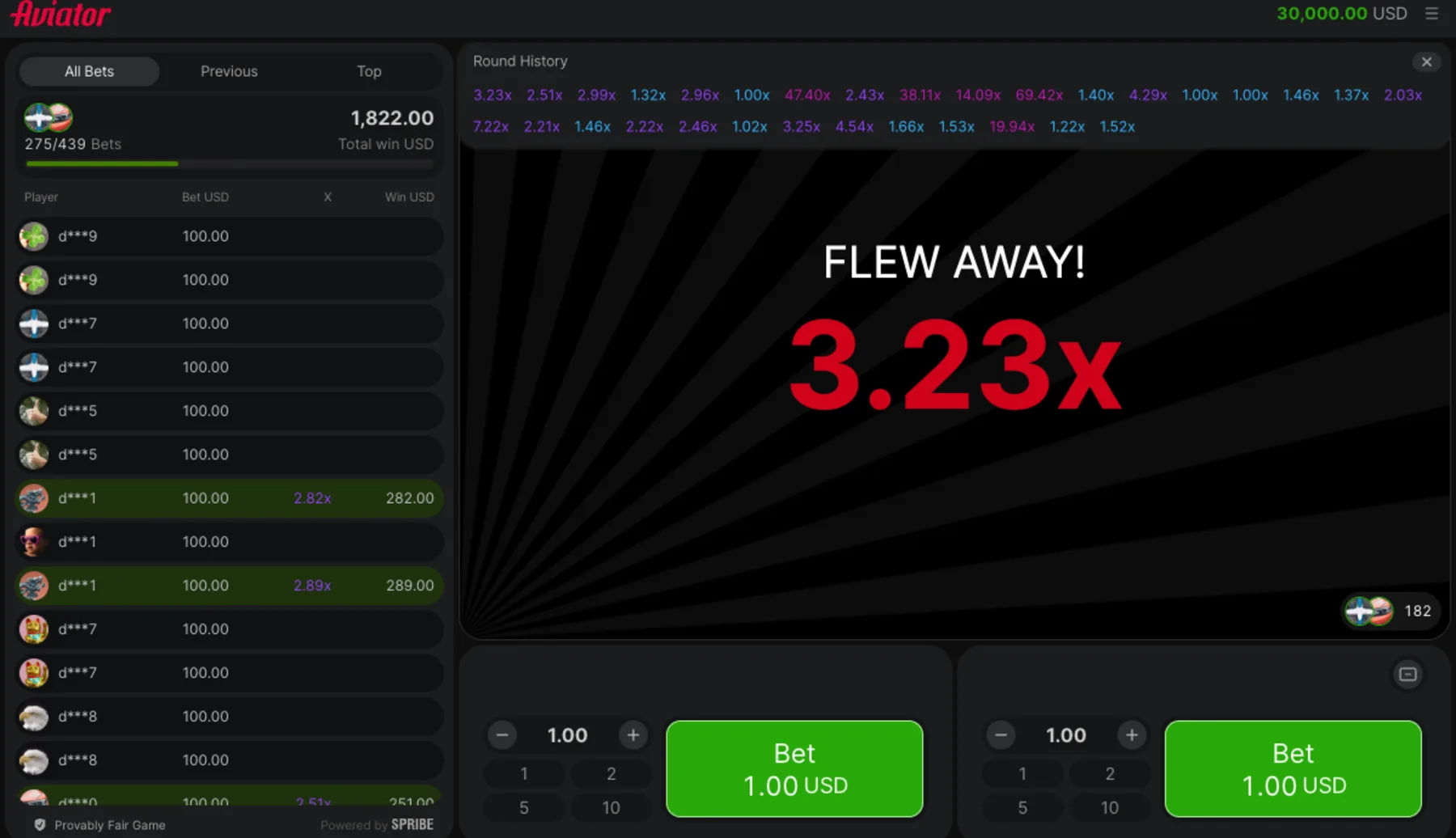
Read it the other way and something useful falls out. A 69.42x round, which sat in the demo's history strip at 18:16, works out at about fifty-one seconds of flight. Big multipliers aren't a jackpot mechanic; they're patience that happened to be rewarded.
The curve simply keeps going.
There is no ceiling anywhere in that formula. Spribe publishes no maximum multiplier and no win cap for Aviator, and the client carries none by default. What our ceiling explainer covers is the part that does exist: optional operator settings that stop the round early.
The Missing Return Figure
Spribe's own demo never shows you a return-to-player figure. We read the whole GAME RULES panel on , all 3,540 characters of it, and the return line, the formula line and the maximum-win line are simply absent, because the deployment supplies no values for them.
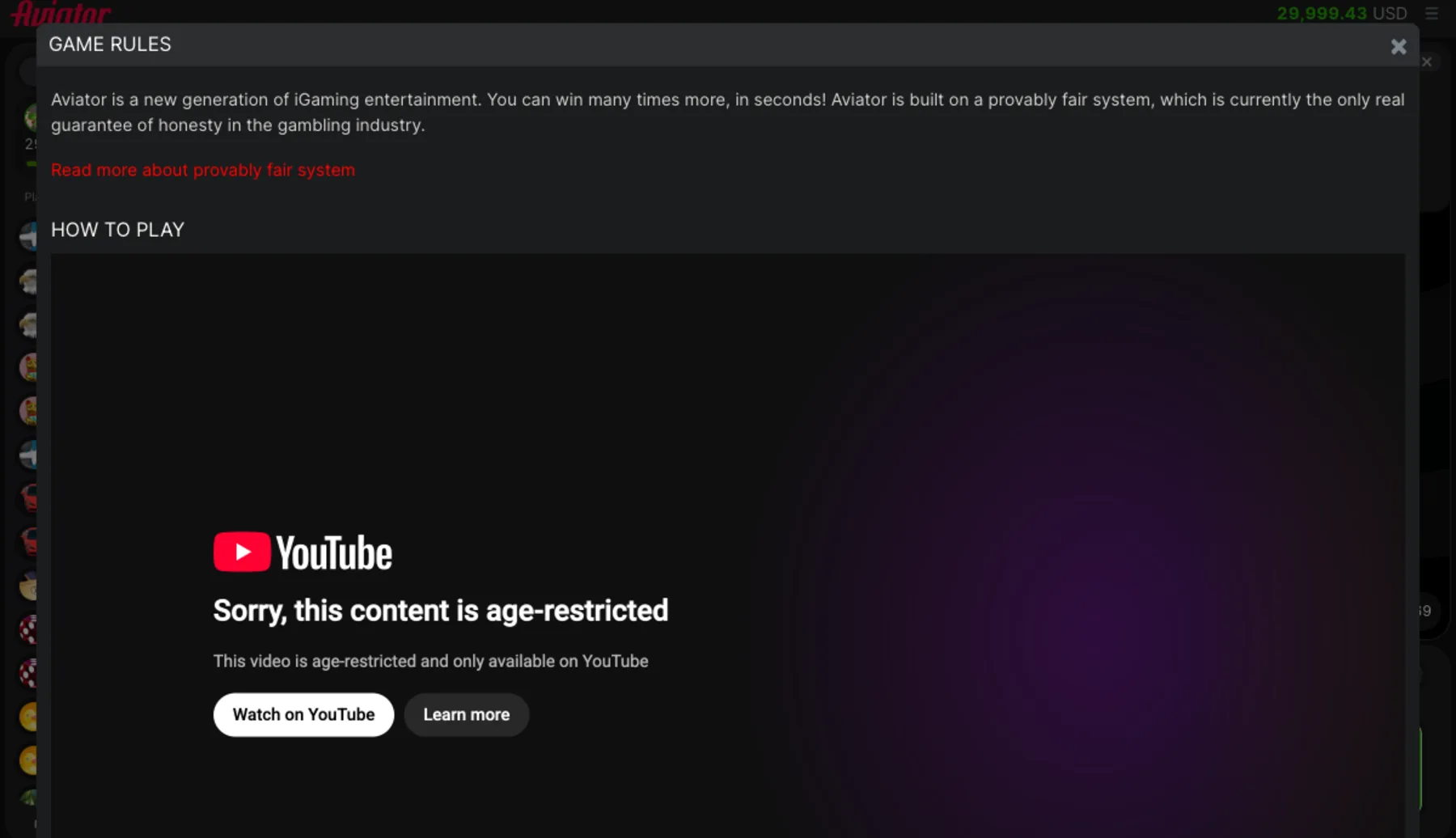
The 97% everyone quotes lives in exactly one place: a single row on the Aviator product page. The rules screen inside the client renders that sentence from a variable, which means the figure travels with the deployment rather than with the game. Our return-to-player page works through what that means for a lobby you are actually sitting in.
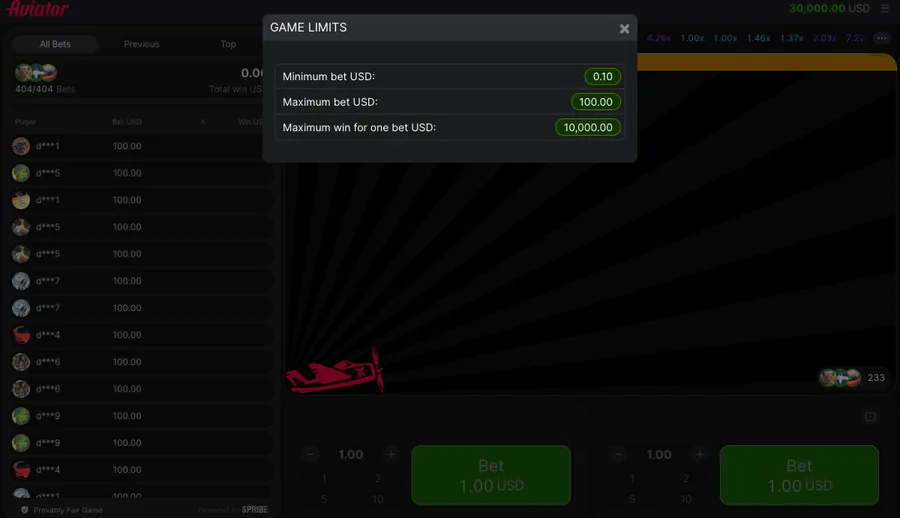
The GAME LIMITS panel is blunter still. In Spribe's USD demo it printed three rows and only three: a minimum bet of 0.10, a maximum bet of 100.00 and a maximum win for one bet of $10,000.00. No multiplier row at all, although the client's own text file carries a label for one. That gap is the clearest evidence we found that caps are settings, not properties.
Ten Rounds, Written Down
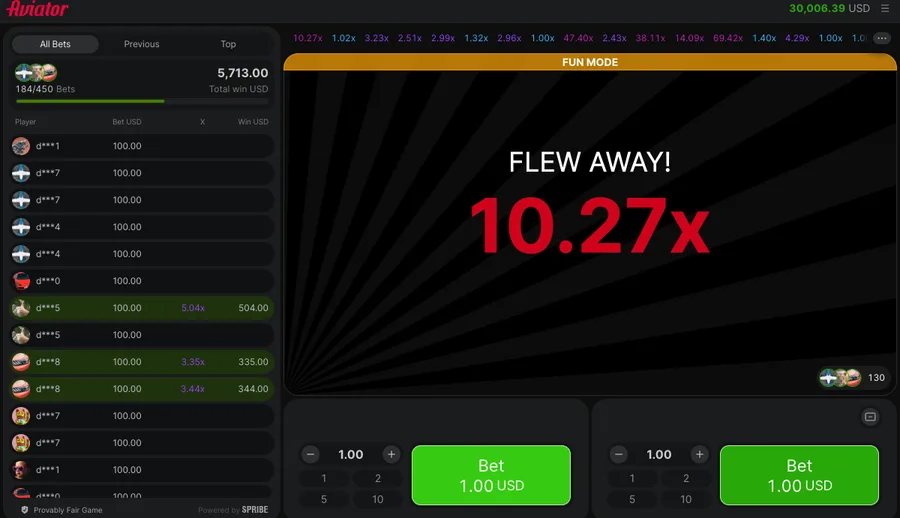
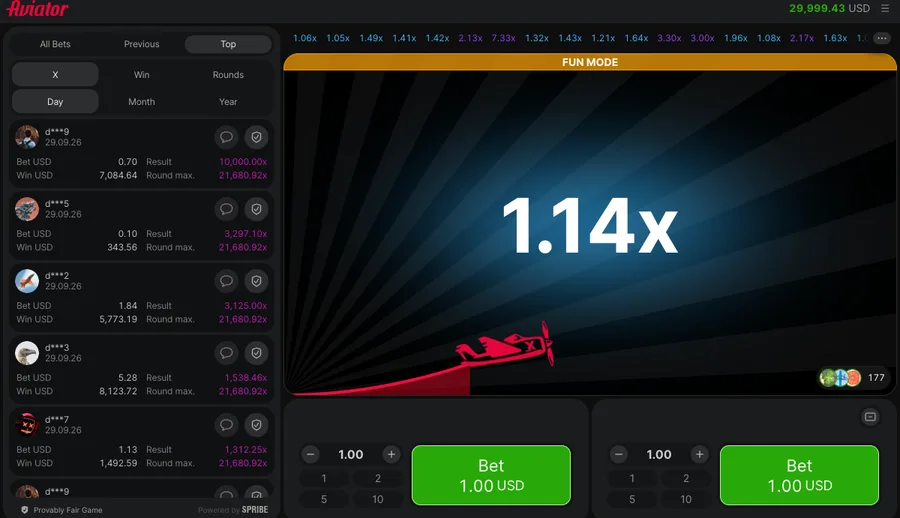
Here's what a small, honest session looks like. On , between 18:16 and 18:26, we staked $1.00 a round in the official demo, ten rounds in a row, starting from 30,000.00 in play money. Two rounds paid. Eight didn't. We got back 9.43 of the 10.00 we put in, a session return of 94.3%, and the closing balance read 29,999.43.
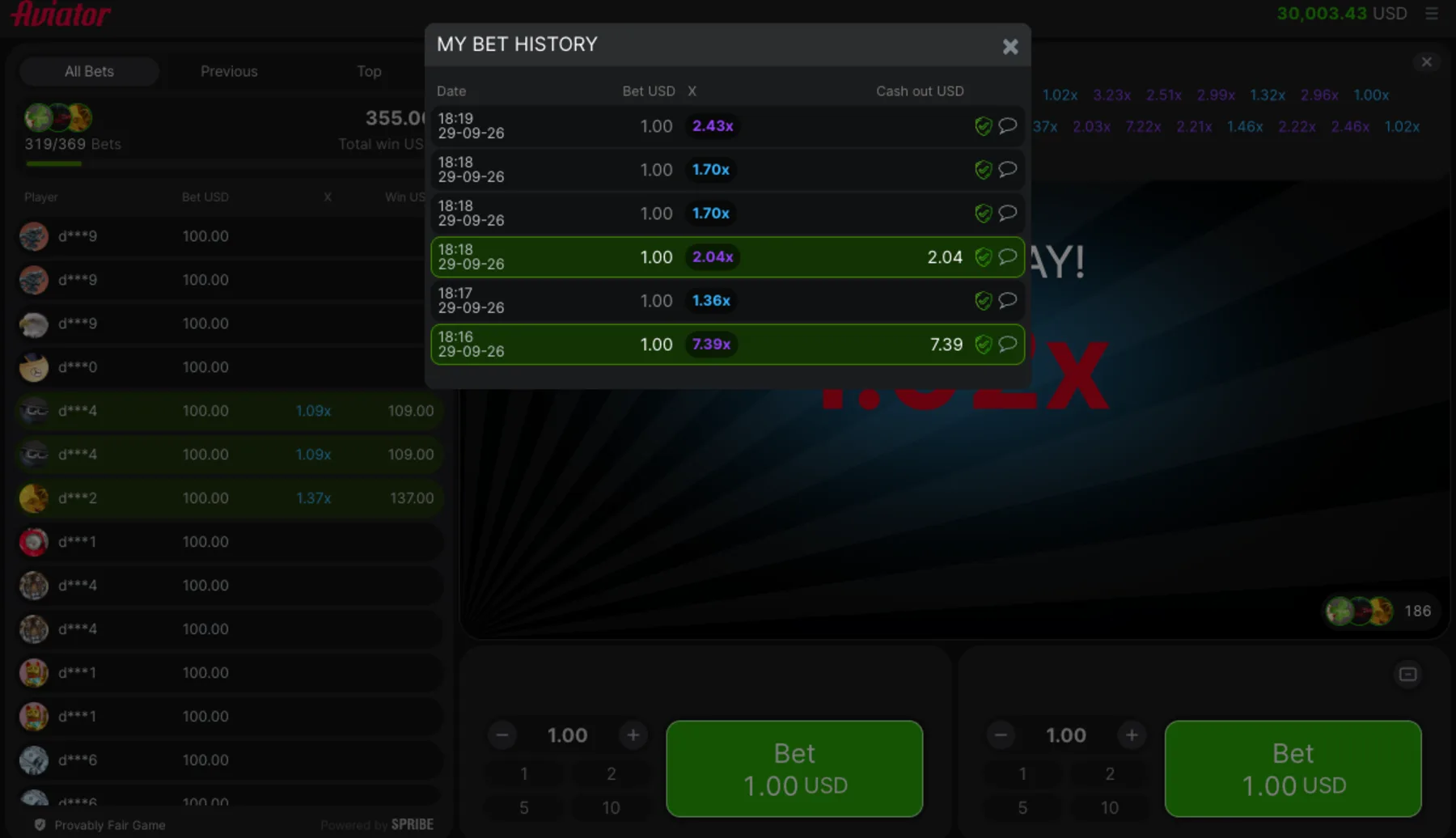
One wrinkle in the client's own log is worth flagging, because it trips people up. The X column carries the cash-out multiplier on a round you won and the crash multiplier on a round you lost, so the two columns are not the same measurement. We know the 18:16 round carried on to 10.27x only because the screen said FLEW AWAY after we had already taken 7.39x, and for the 2.04x round we never saw where the plane stopped.
Ten rounds measure nothing at all, and we'd rather say so than dress it up. One round, the 7.39x cash-out at 18:16, produced 78% of everything we got back. Strip it out and the session is a straight loss.
Eight losses out of ten is an ordinary run.
The losses are the interesting part. Several of those rounds climbed well past the multiplier our scripted cash-out was aiming at and we still missed them, because the script was polling a button in a browser five times a second. That's a fact about automation latency, not about human reflexes. It is also the plainest argument we can make for using the built-in Auto Cash Out instead of a finger.
We Reproduced Three Rounds
This is where Aviator parts company with a slot. Open any finished round from the bet history, press the green icon, and the client hands you the server seed, the client seeds of the first three bettors, the combined hash and the result. We checked whether those pieces actually fit.
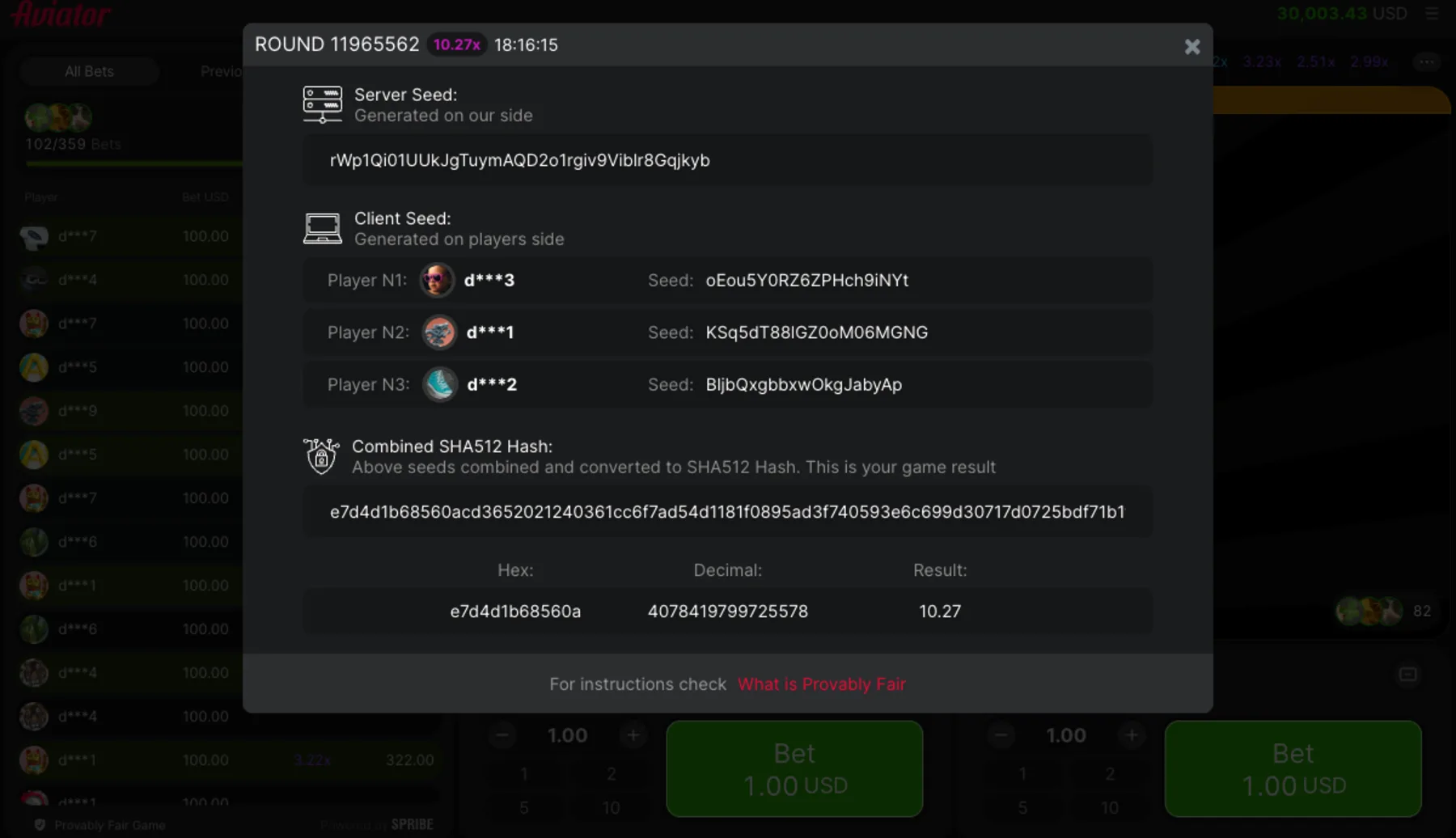
They do. Take round 11965562, which ended at 10.27x. Join the server seed and the three player seeds end to end, with nothing between them, run SHA-512 over the result, and you get the hash the panel prints. Its first thirteen hexadecimal characters read as the decimal 4078419799725578, exactly as shown. Push that through floor(97 * 2^52 / (2^52 - h)) / 100 and the answer is 10.27. Round 11965577 reproduces at 2.43x and round 11965609 at 1.64x by the same three steps.
Notice the constant sitting inside that formula. It is 97, the same number Spribe prints as the return to player, which is a stronger reason to trust the figure than the studio's own web page. From it, two things follow arithmetically rather than by assertion: a round reaches a multiplier of m roughly 0.97 divided by m of the time, and just under 4% of rounds end below 1.01x, which is what a 1.00x entry in the history strip means.
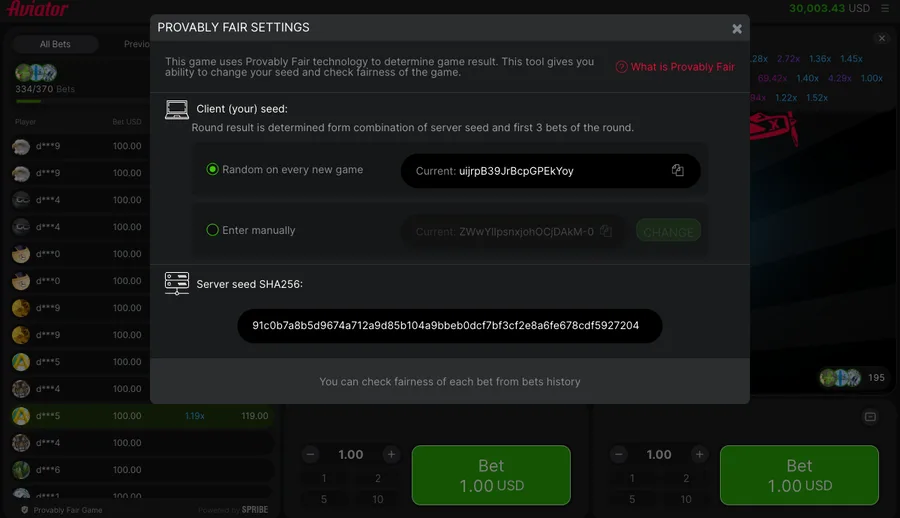
We checked three rounds, not the whole game, and we won't pretend otherwise. What we could not do was close the commitment loop. The settings screen publishes a hash of the next server seed, we recorded it, we watched it rotate, and none of the seeds later revealed matched what we had written down. We don't know why, the client documents neither the rotation rule nor which commitment belongs to which seed, and each game room runs its own. Our provably fair page lays out both halves in detail.
The Studio Behind It
Spribe OU is an Estonian company, registry code 14540763, on the register since . It holds a UK Gambling Commission gambling software licence, account 57302, number 057302-R-333085-003, active since , and the same register carries one regulatory action against it: a warning dated for operating without the appropriate licence between and . The Commission also recorded that the company "co-operated with the Commission throughout the investigation and took corrective steps to address the identified concerns".
None of that makes the game rigged, and we're not going to imply it does. It does mean the supplier's paperwork is worth reading before a deposit, which is what our Spribe review is for.
Lobbies That Carry It
Six operators we checked carry Aviator with evidence we could stand behind, and they behave very differently around it. Stake publishes a 97.00% return and a 3.00% house edge on its own game page, and its lobby data backs the edge up, yet it forbids the game outright while a wagering requirement is running. Pin-Up goes the other way and lets the game clear a bonus at 10% of the stake. Batery is stranger still: it runs a welcome bonus that can only be wagered on Aviator, at 40 times, inside seven days.
4rabet prints a minimum stake of 8.5 rupees and a maximum of 8,400. Melbet and 1xBet sit on the same platform, share the same internal game id and the same terms template, so treat them as one source rather than two.
Flight Time Against Multiplier, by the Client's Own Formula
| Seconds in the air | Multiplier reached |
|---|---|
| 1 second | 1.08x |
| 5 seconds | 1.51x |
| 10 seconds | 2.29x |
| 30 seconds | 12.06x |
| 60 seconds | about 145x |
Our Aviator Verdict and Rating
Key Terms Used on This Page
- Crash game
- A round where a multiplier climbs from 1x until it stops, and a stake pays only if it is cashed out first.
- Server seed
- A random string the operator generates per round; for round 11965562 it combined with three player seeds into one SHA-512 hash.
- Client seed
- The seed each player carries; only the first three bettors of a round feed into that round's result.
- Auto Cash Out
- A client setting that closes a bet at a chosen multiplier, accepting values from 1.01 to 100.
- Round history
- The strip of past results above the game, thirty entries deep in the snapshot we read at 18:16.
Not sure yet? Try the free demo first and learn the round with play money before any deposit.
Try the free demo first →Deposits and identity checks stay on the operator's own secure site.
Related Reading on This Game
More on this game, from the same section first:
 Reviews
Safe or Scam?
3 rounds rebuilt, commitment unverified
 Reviews
The Studio Behind It
UK account 57302, warning 12 June 2026
 Guides
Round walkthrough
Cash out above 1.00x or lose
 Casinos
4rabet Limits and Bonus
Stake floor INR 8.5, wagering x25
 Reference
Max Multiplier Claims
No ceiling published; demo caps 10,000.00 USD
What Else Do Readers Ask?
These are the questions readers send us about Aviator itself rather than about a particular casino, answered from the official demo and from rounds we recomputed.
What does a 1.00x result mean?
A 1.00x entry means the plane left at once and every stake in that round was lost. Three of thirty results in one history-panel snapshot read that way.
Can you play Aviator without an account?
Yes. The official launcher hands out 30,000.00 of play credit, asks for no sign-in and no payment, and keeps the screen marked FUN MODE.
Does Spribe publish a volatility rating?
No. Spribe states no volatility figure for Aviator anywhere, so any low, medium or high label you read comes from a catalogue rather than the studio.
How long is a typical flight?
Rounds we played ended as low as 1.36x and as high as 10.27x. The history panel at 18:16 held a 69.42x, which the client's own curve puts near fifty seconds.
Why can nobody predict the next multiplier?
Because the result is fixed by a hash of four seeds before the plane moves. Software sold as a predictor cannot see it, and some of it carries malware.
Where does the 97% figure come from?
Spribe prints 97% in a single row on the Aviator product page. That same constant sits inside the round formula we rebuilt from three recomputed rounds.
Which numbers change between casinos?
Stake limits, the money ceiling for one bet and the return figure are all deployment settings. Spribe's demo ran 0.10 to $100.00 a round.
How do we test a crash game?
We open the official demo, log every round from the client's own history panel, then recompute results from their seeds and compare against the screen.